|
|

World of motorcycleS |
|
|
|
World of motorcycleS |
|
|
Matchless info, photo's & links
1899 The Collier Brothers first experimented with power. This machine had the de Dion 2.75 h.p engine mounted above the front wheel of one of their standard bicycle. This did not work too well. 1901 They produced an experimental version using a european engine whereby the engine was crammed into the space between the seat tube and the rear wheel. This model was not successful as it had a tendency to overheat in use. 1902 They then went into production using a 2.75hp De Dion engine that was hung from the frame downtube. Both brothers became successfully involved in competition. 1903 Saw the arrival of a more powerful machine, fitted with a 3.5hp MMC De Dion engine? or just a De Dion. I'm not 100% which was used. 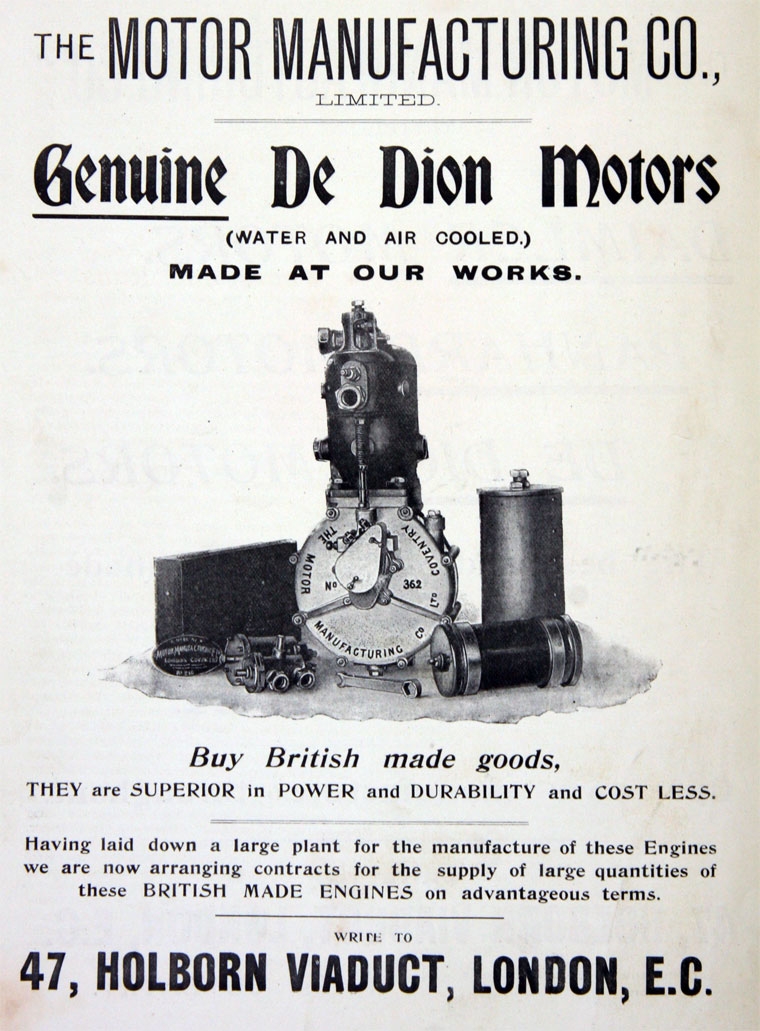 1904 forecar built. Sorry no photo's found 1905 They now added suspension to their machines and later that year they produced a model fitted with a 6 hp V twin JAP engine and began experimenting with leading-link front ends & swinging fork rear suspension Harry represents England in International Cup Race, France 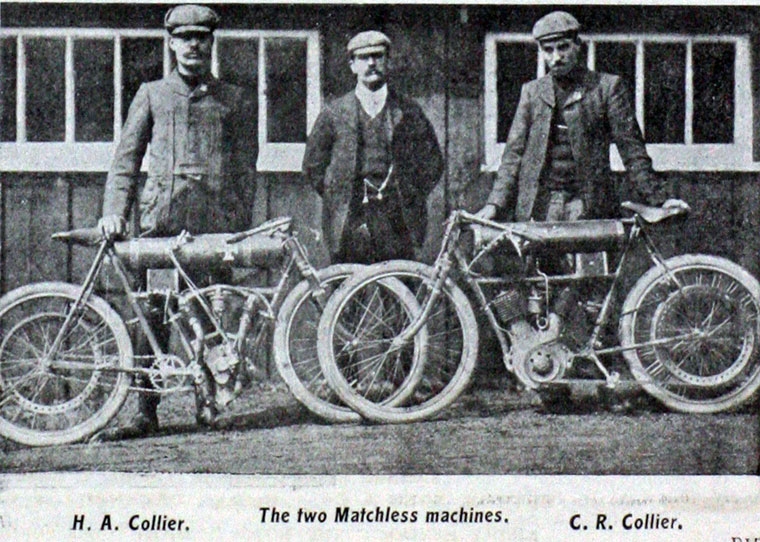
That year also saw success in competition and both brothers were selected for the International Cup Race. 1907 At the very first TT race, Charlie Collier led from start to finish. Charlie won 38.23mph Harry lay second. .. Collier took over on his pedal-assisted Matchless, but his brother Harry was not so lucky. He was forced out with serious engine trouble, having set the fastest lap in the class: 23m 05s (41.81 mph). Charlie Collier went on to win from Marshall and Hulbert but his victory, like many subsequent TT wins, was not without controversy. With the help of his pedals, Collier completed the race at an average of 94. 5 miles to the gallon. The Triumph of Marshall, without assistance, averaged 114 mpg, and it was argued that Marshall would have won if he'd fitted pedals. The easiest means of avoiding such disputes was adopted the following year when pedals were banned. As it goes, the Collier family donated a TT cup. (Source iomtt.com & Gold Portfolio) 1908 Further revisions came along with a two-speed gear and a TT model with an ohv engine similar to the one that won the TT. Further attempts were made at the TT but without success, although Charlie broke the world one-hour record riding at Brooklands. 1909 Road models used JAP engines - 2.5hp and 3.5hp singles and a 6hp V-twin. Rigid or spring frames, two-speed gears and ignition options were available, while the 3.5hp White and Poppe engine was also an option. Early in the year Harry set a twenty-four hour record at Canning Town, averaging over 32 mph, despite problems and delays. Further success came when Brooklands began to run motorcycle races, and there was another win at the TT. Harry sets 24hr world record averaging 32.3mph 1910 Compatition success continued and by now the brothers had taken three of the first four races at the TT. The range expanded and the main engine in use was the JAP. Belt drive remained. 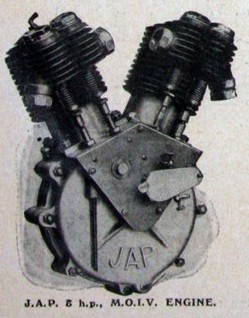
Photo dated as 1911 1913-1917 For a list of the models and prices of motorcycles see the 1917 Red Book 1915 During WWI some machines were built for service use although they were not contracted to make motorcycles for the army. They announced proposals for a flat-twin, three speed engine, but nothing came of it. Post WWI The company continued to produce the model they had supplied to the army - this was listed as the Victory and sold in solo or sidecar form. New, bigger and better models were added year on year throughout the 1920s. 1929 The Model X first saw the roads: 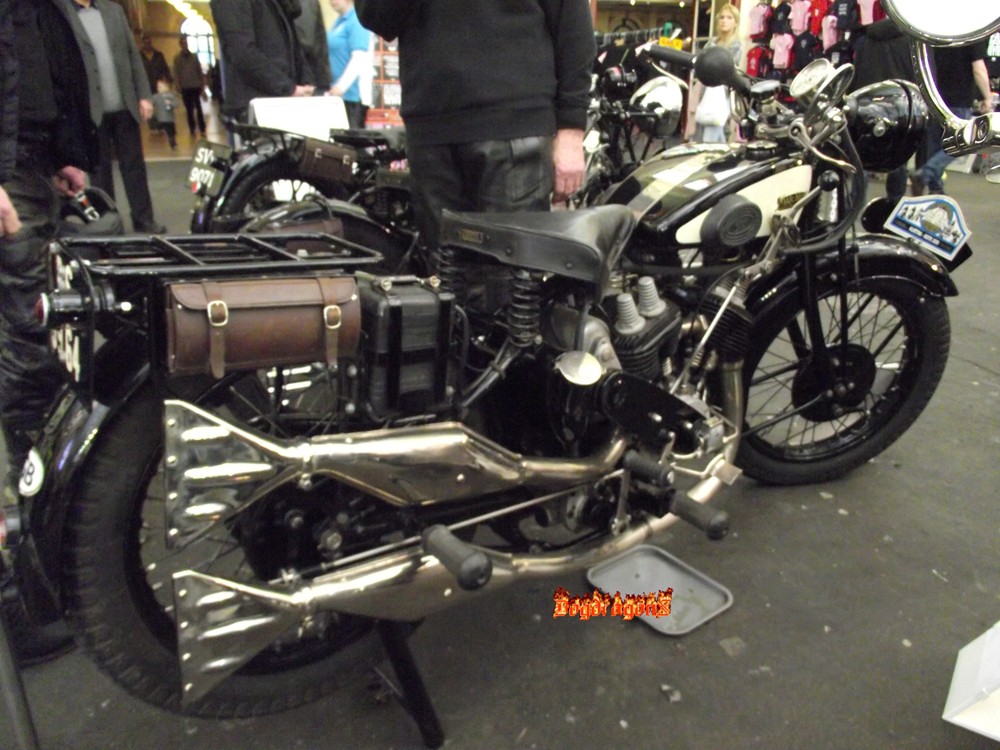
990c Matchless engine Click on photo for 8 more photo's The company acquired AJS. 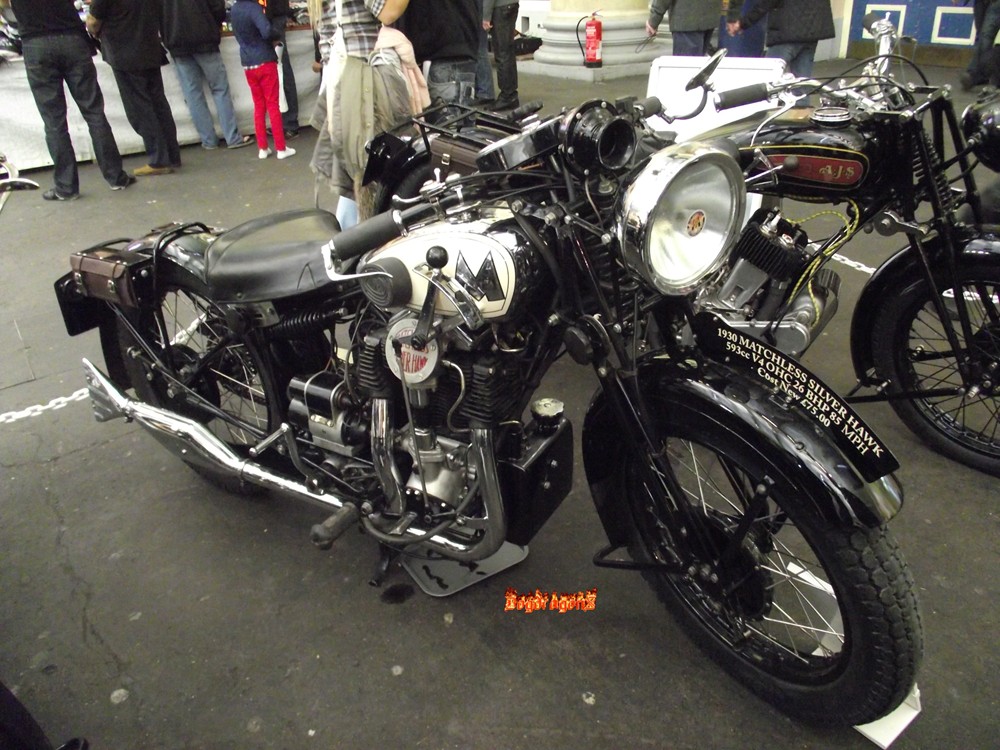
Silver Hawk 1930 Click on photo to see 10 more photo's 1932 CS 500cc Sloper introduced 1933 Silver Arrow V twin 400cc as well as many more. The Model X has changed slightly. 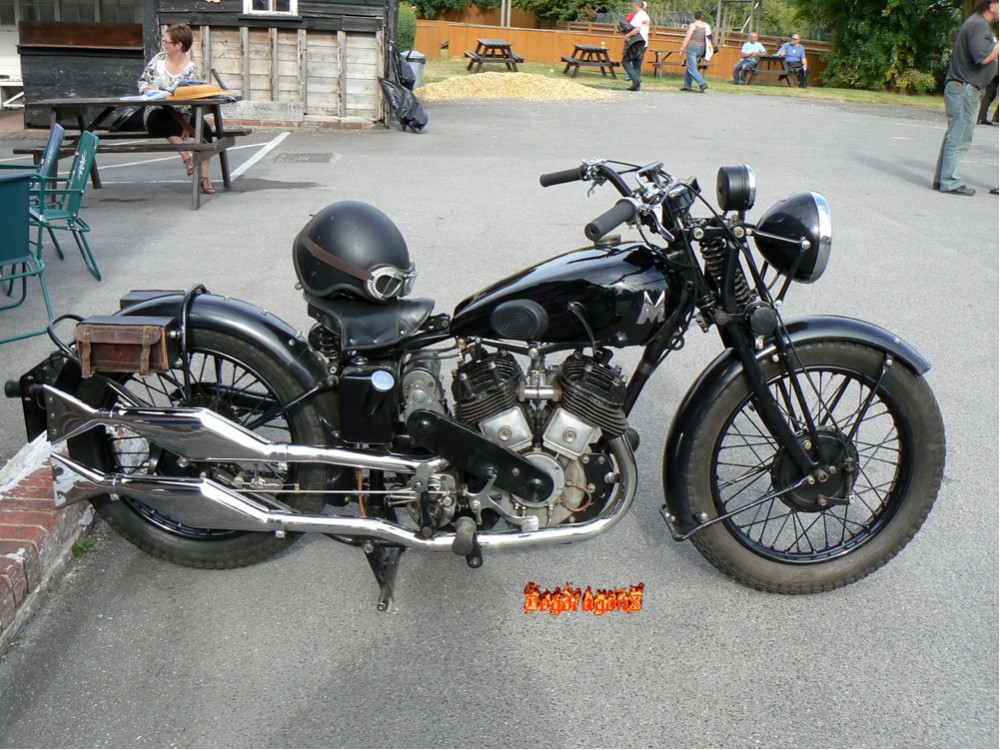
Model X 1933 Click on photo for more Only difference between Matchless & AJS besides the logo? Matchless magnito in front of the cylinder(s), AJS had the magnito behind. The old V-twin engine was refreshed and was still used for sidecar models. 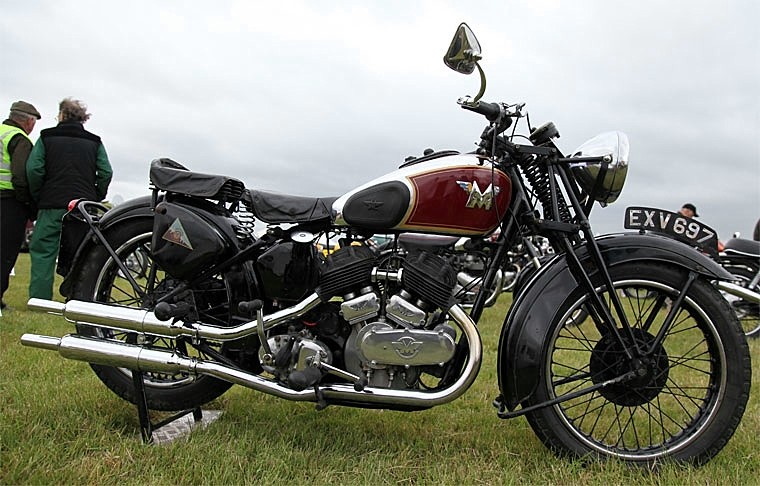
1937 Model X Photo Coutesy Gracysguide
1939 Matchless now had twelve models in their range and all but one twin were of the G-series. During World War II, Matchless made more than 80,000 G3 and G3L models for the armed forces. 1940 Fewer models were listed because the company were supplying machines to the services 1941 The G3 became the G3L and a firm favourite within the services. It was light, easy to manoeuvre as they now had introduced telescopic front forks called "Teledraulic" forks, considered by some to be the first major innovation in front suspension in 25 years. 1943 Although the AMC name remained, the company sold Sunbeam to BSA. Post War. The fortunes of AJS and Matchless had become closely intertwined. 1952 listed 9 models. one twin & eight singles. This is the year that Matchless & AJS became nearly the same machines, Only difference between the Matchless & AJS machines was the logo 1956 models that year the new 600cc twin & the 500cc twin, two singles, 350 & 500cc The G80CS The G 45 road racer & a trials machine, G 3LC The range stayed the same until 1959 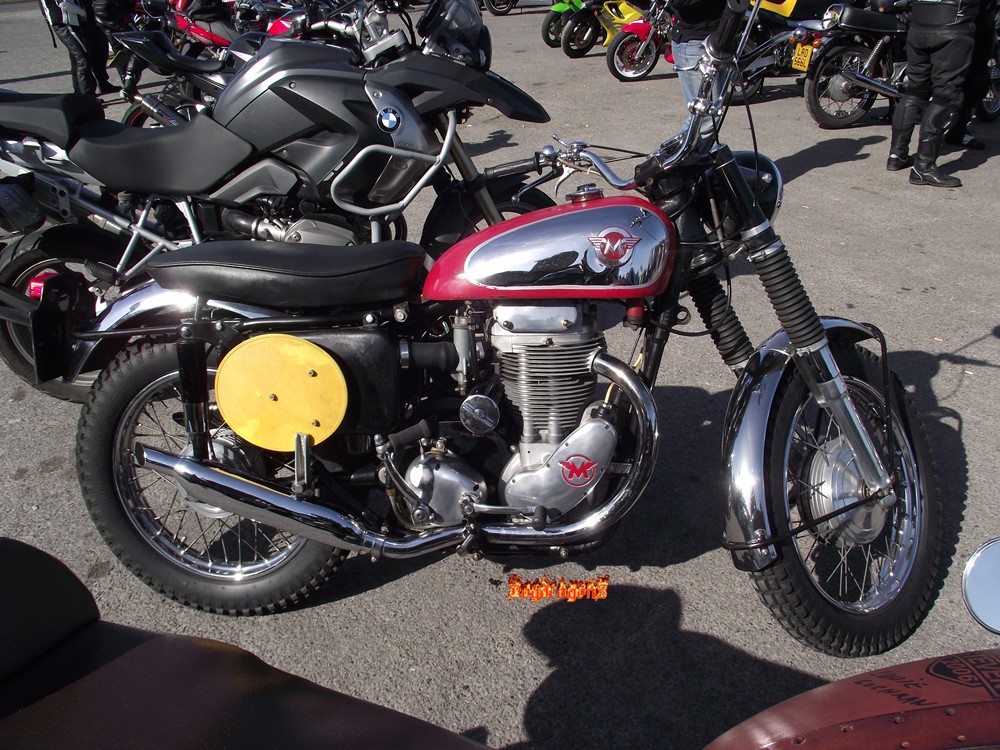
G 80 CS Click on photo to see 14 more photo's 1963 The last of the G50 racers 1966-67 G 85CS 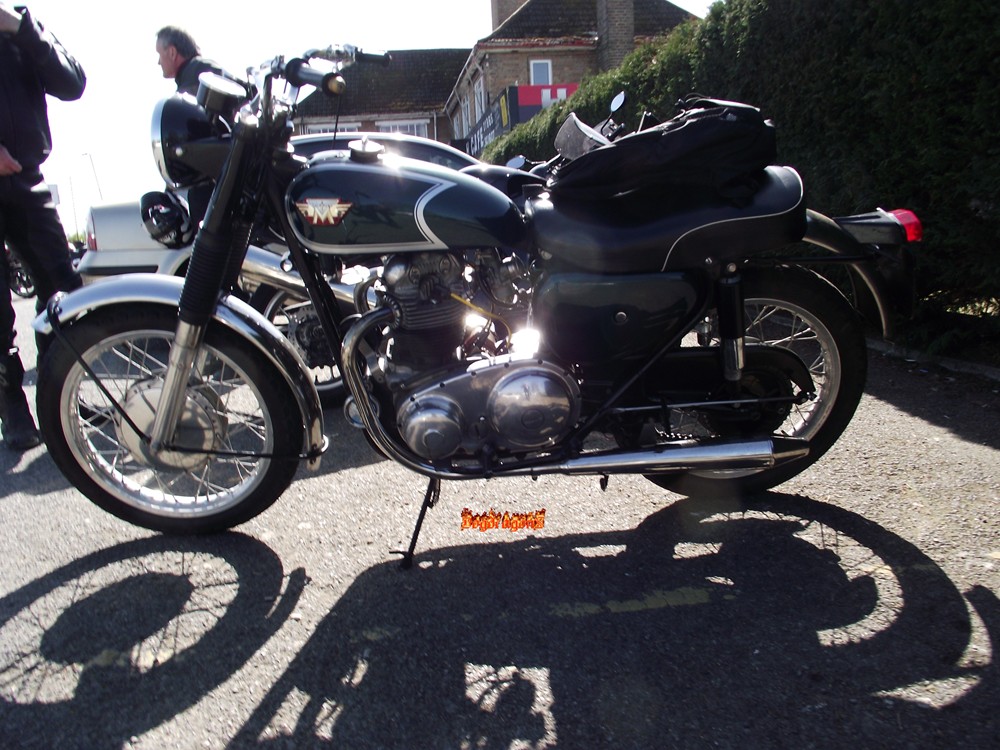
Think I got this one mis-labeled. Click on photo for more 1990 Sales were slow, so the motorcycles were produced for special order only. 1993 Production ceased. Scources Gracysguide & the A.J.S. & Matchless Gold Portfolio 1945-1966 & other places.
|
 ©2013
all rights reserved
©2013
all rights reserved